Even the Smallest Person: Finding Your Voice in a Changing World (Keynote address by John Wambugu)
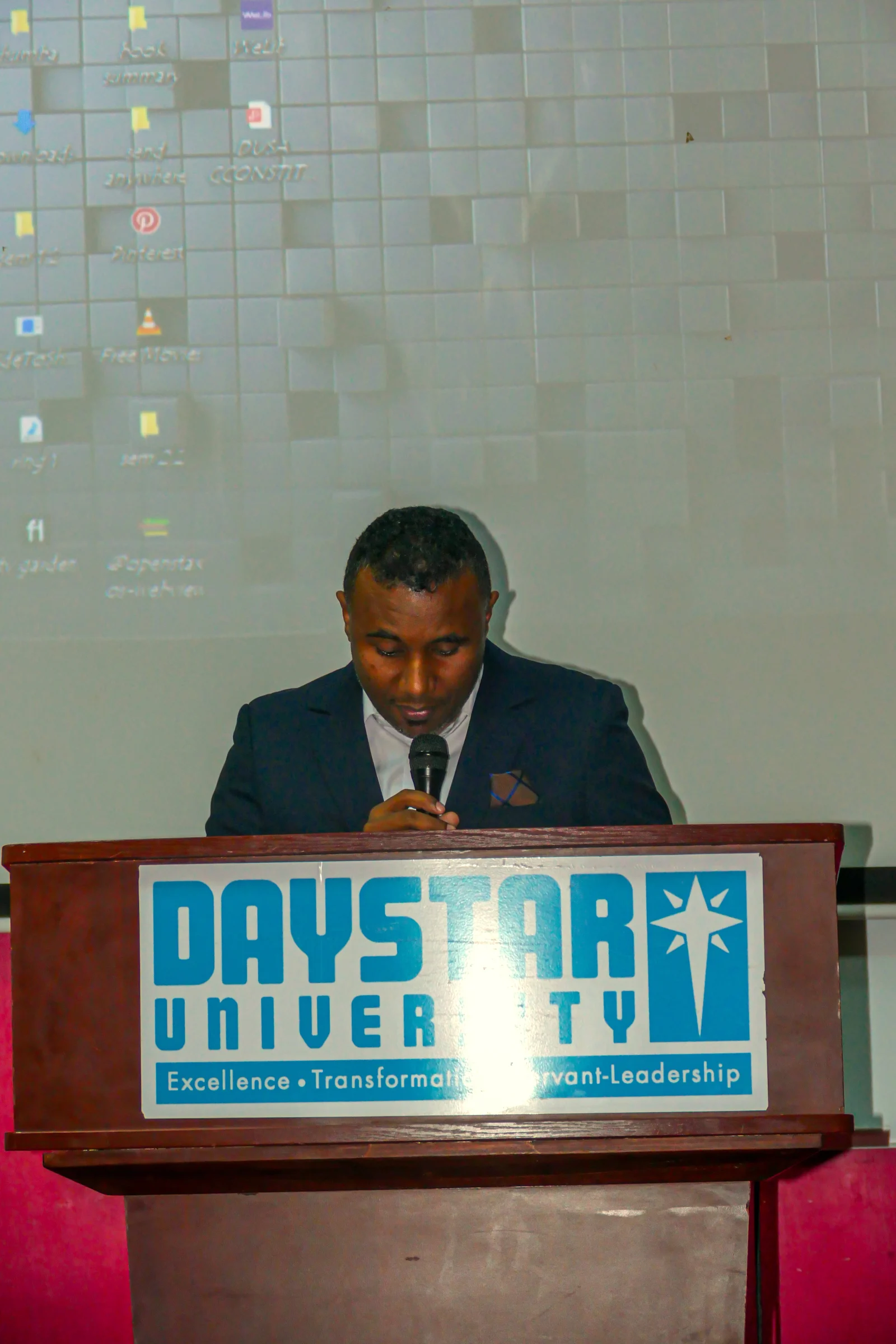
In his keynote address at Daystar University, John Wambugu explores how to find an authentic voice in a world shaped by changing technology. Drawing on lessons from J.R.R. Tolkien, Wangari Maathai and Robert F. Kennedy, he reflects on why the future belongs to those who lead with integrity.
EVEN THE SMALLEST PERSON
Finding Your Voice in a Changing World
Keynote Address, Delivered on Thursday 06.08.2026
Daystar University Media Week Gala & Grand Finale
John Wambugu
Good evening.
Vice Chancellor, members of faculty, distinguished guests, industry leaders, the team from Shine FM and most importantly the students of Daystar University.
Thank you for inviting me to share this evening with you.
When the organisers invited me, they asked me to reflect on navigating technology, artificial intelligence and truth in Africa's evolving creative economy.
Those are important conversations. But this evening I want to approach that conversation through a much simpler question.
How do we find our voice in a changing world?
I have come to believe that before we can change the world around us, we must first understand what shapes the world within us.
Before I speak about journalism, communication, technology or the future, let me tell you something about myself.
I love the story of the underdog.
Perhaps that is why I have always loved The Lord of the Rings, the timeless story written by the British author J.R.R. Tolkien. For generations, it has reminded readers that courage often comes from the most unlikely people.
One of the heroes of that story is a little hobbit named Frodo. Hobbits are ordinary people. They are small in stature. They are not kings. They are not great warriors. They are the last people anyone would expect to carry the future of the world.
In many ways Frodo reminds me of David standing before Goliath.
There is another character I admire just as much. Her name is Galadriel. She is one of the wisest leaders in the story. Throughout her life she has watched kingdoms rise and kingdoms fall. She understands something many powerful people never learn. That real greatness is not measured by strength, position or power. It is measured by courage.
At one point Frodo says to her, "Then I know what I must do. It's just... I'm afraid to do it."
Galadriel quietly replies, "Even the smallest person can change the course of the future."
I don't think she was only talking about a hobbit.
I think she was talking about us.
Because if we are honest every one of us has had a Frodo moment.
A moment when we knew what we wanted to do but wondered whether we were enough.
Perhaps some of you feel that way tonight.
You have chosen journalism, communication, film or media. You love telling stories.
But you also wonder what the future will look like.
Will there still be room for your voice?
If there is one question I hear more than any other from young people, it is this: "Will artificial intelligence take my job?"
It is an honest question. And it deserves an honest answer.
My answer is... not if you keep learning.
AI will certainly change jobs. It will change how we create. It will change how we communicate. It will even change how stories are told.
But every generation has had its defining technology. The printing press, radio, television, the internet and now AI.
The people who thrive are rarely those who resist change.
They are the people who keep learning, keep adapting and keep finding new ways to serve others.
Those questions are real. But uncertainty has never stopped history from being made.
Sixty years ago another university invited a speaker to encourage young people facing an uncertain future.
His name was Robert F. Kennedy, the younger brother of President John F. Kennedy and one of America's leading voices for justice and public service.
In June 1966 he stood before students at the University of Cape Town during apartheid. Many believed the future had already been decided.
Kennedy believed otherwise.
He reminded those students that "the future may be beyond our vision but it is not entirely beyond our control."
Different country. Different generation. Different challenge. The same choice.
Will we allow the future to happen to us or will we help build it?
That question has shaped my own journey.
For many years I have had the privilege of working with young people, creators and entrepreneurs across Africa. I have met people with extraordinary talent and ordinary beginnings. Along the way, I discovered that technology is simply a means, never the destination. The lesson that has stayed with me has never really been about technology. It has always been about people.
I have come to believe one simple thing. Technology is only successful when it improves livelihoods.
If it helps a student discover their potential, it matters.
If it helps a journalist uncover the truth, it matters.
If it helps an entrepreneur create opportunity for others, it matters.
If it helps a community solve a problem, it matters.
Technology should never become the story. People should.
People often ask me, "With everything changing so quickly, what gives you hope?" My answer surprises them.
It isn't artificial intelligence. It's human intelligence. It's human creativity. It's human courage.
Every generation is given new tools. History remembers what people choose to build with them. The future will not be decided by technology alone. It will be decided by the choices we make with it.
I tell them I am asking a different question.
How do we become journalists that no machine can replace?
Machines can predict words. People pursue truth. Machines can produce information.
People create meaning. Machines can work quickly. People build trust.
And trust has always been the heartbeat of journalism.
There is another remarkable person whose story inspires me.
Professor Wangari Maathai was the first African woman to receive the Nobel Peace Prize. She planted millions of trees, but perhaps her greatest lesson came through a simple story.
She told of a forest on fire.
All the animals ran away because the fire was too big.
Only a tiny hummingbird kept flying to the river, carrying one drop of water at a time.
The other animals laughed.
"You will never put out that fire."
The hummingbird replied, "I am doing the best I can."
What a beautiful lesson.
You may not change the whole world tomorrow.
But you can tell one honest story. You can ask one brave question. You can expose one injustice. You can encourage one young person.
You can make one community better than you found it.
Mother Teresa once said, "We cannot all do great things. But we can do small things with great love."
I think journalism is exactly that.
One interview. One photograph. One article. One documentary. One conversation.
Small things done with great love for people and great respect for the truth.
So as you leave this Media Week I hope you remember four things.
Never stop learning. Protect your integrity. Use every new technology wisely but never let it replace your humanity. And wherever life takes you ask yourself one question.
Whose life is better because I was here?
One day the banners from this week will come down. The lights will go off. The cameras will be packed away.
But your voice will remain. Use it to tell the truth. Use it to build hope. Use it to serve. Use it to lift others.
Because the future economy will reward those who combine technology with humanity, innovation with integrity and success with service.
And whenever you begin to doubt yourself remember the words of Galadriel.
"Even the smallest person can change the course of the future."
I believe the next great journalist may be sitting in this room. The next great storyteller may be sitting in this room. The next person who changes Kenya, Africa or even the world may be sitting in this room.
Why not? Why not you?
History has always been changed by ordinary people who decided to do extraordinary things. And every one of those people began exactly where you are today.
Thank you and may God bless you all.
New here? Start with the Future Economy Framework — the thinking behind these insights.
For Publishers & Media
Interested in republishing this article?
Download a publisher-ready version below or submit a republication request. Please retain author attribution and include a link back to the original article.
© 2026 John Wambugu. Technology, Innovation & Future Economy Leader. Building Africa's Future Economy.